Marbella Ahead of London and Paris: Anatomy of a Repricing
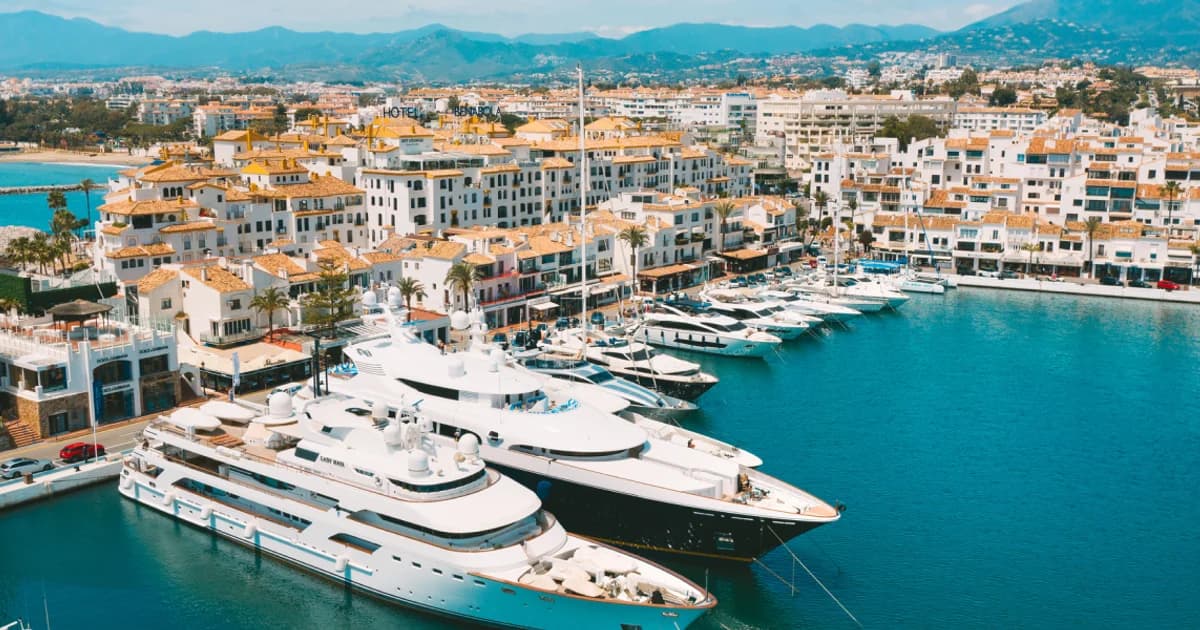
One million dollars invested in prime residential buys 82 square metres in Marbella. The same budget gets you 46 square metres in London. 39 in Paris. 37 in New York. 33 in Monaco.
This is not a projection. It is the direct measure published in Knight Frank's The Wealth Report 2026, through its PIRI 100 index — the reference benchmark for global prime residential markets. The conclusion is unambiguous: Marbella now delivers more residential value per dollar invested than the established benchmarks of international luxury real estate.
The repricing is not new — but its magnitude is. Prime residential in Marbella rose 8.1% in 2025. The global average for luxury markets over the same period was 3.2%. The gap is structural, not cyclical.
A market in maturity, not overheating
The data in DM Properties Knight Frank's Market Report 2026 offers a more nuanced reading than any headline figure. The Triángulo de Oro — Marbella, Estepona, Benahavís — recorded 8,540 residential transactions in 2025. Marbella accounts for more than half (4,379), ahead of Estepona (3,449) and Benahavís (712).
Volume moderated by approximately 4.5% compared to 2024, following a 6.75% rise the year before. Market participants read this as normalisation, not reversal. Prices continued to rise: €4,424/m² in Marbella (+7.67%), €4,100/m² in Benahavís (+9.24%), €3,218/m² in Estepona (+10.89%).
The most instructive signal lies elsewhere. The average gap between listing price and final sale price reached 13.63% for villas and 11.10% for apartments in 2025. Translation: correctly priced assets sell. The market filters. That is the signature of maturity, not euphoria.
In Q1 2026, transactions declined 35.6% versus Q4 2025 — a seasonal effect compounded by a market entering consolidation. Prices held. The trajectory describes a market that has absorbed several years of rapid growth and is finding a new equilibrium.
Supply structure prevents normalisation from above
Supply constraint is the most underestimated argument in any Marbella analysis. Prime land in the most sought-after zones — Milla de Oro, Sierra Blanca, Nueva Andalucía, Los Monteros, La Zagaleta, El Madroñal — is structurally finite. Planning regulations preclude any meaningful densification. What the market cannot produce, time does not restore.
In several of these micro-markets, available supply is insufficient to meet existing demand. This scarcity supports prices in the ultra-prime segment regardless of macro cycles.
A deeply diversified international buyer base
Demand in Marbella is no longer driven by a single buyer profile. The traditional presence of British, Swedish, German, Dutch and Scandinavian buyers is now supplemented by structural demand from North America, the Middle East, Poland and Eastern Europe.
This shift in geographic composition matters. A market dependent on one nationality of buyers is exposed to that country's tax policy, currency shocks or political cycles. A market distributed across ten or fifteen nationalities is structurally more resilient.
The UK's non-domiciled resident tax reform, in force since 2025, has mechanically accelerated the flow of private capital toward Spain. This is not a one-off effect — it is a patrimonial migration.
What Marbella offers that competing markets cannot replicate
The comparison with competing markets is instructive beyond the price-per-square-metre figures.
Dubai offers attractive gross yields (5–7%), but extreme short-cycle volatility, insufficient legal protection for non-resident buyers, and a hydrocarbon dependency that weighs on long-term visibility.
The Côte d'Azur carries established prestige, but France's wealth tax on real estate (IFI), high transfer taxes and reduced liquidity on large floor areas diminish its patrimonial appeal for non-resident structures.
Miami presents a deep and liquid market, but hurricane and flood insurance costs are rising structurally in the prime segment, and HOA constraints complicate wealth structuring.
Marbella, in the €3M–€10M segment, offers a combination that few markets replicate: twelve-month habitability, a European legal framework, competitive tax treatment for non-resident structures, and a valuation differential versus reference markets that remains significant despite the repricing of recent years.
What this means for an institutional investor
The question is no longer "does Marbella deserve a place in the portfolio?" It is: over what horizon does the valuation differential versus London and Paris close?
Branded residences — the structural model of mature hotel markets — are beginning to appear in the pipeline of international operators on the Costa del Sol. Gross yields on prime villas remain in a 4–6% range, a level that covers the cost of capital while preserving latent appreciation. Institutional demand is organising itself.
Spain projects 10% growth in its ultra-high-net-worth population (assets above $30M) by 2031, to cross the threshold of 10,000 individuals. That is tomorrow's domestic demand forming today in a market whose prime supply cannot grow.
A market that filters correctly priced assets from the rest, that consolidates after rapid growth, and whose prime supply is structurally constrained. This is not the description of a bubble. It is the description of a market entering its adult phase.
Source: DM Properties Knight Frank — Market Report 2026 / The Wealth Report 2026 (PIRI 100)