The Gulf Is Investing in Spain. Here's Why It's Structural.
When the Abu Dhabi Investment Authority consolidated roughly €800 million in Spanish hotel assets between 2022 and 2024, the transaction registered as a footnote in the European hospitality press. It shouldn't have. Taken alongside GIC's involvement in the Blackstone HIP Hotels portfolio — 73 Spanish properties, €4 billion in assets under management across a six-year position — the picture that emerges is not opportunistic. It is deliberate, patient, and almost certainly durable.
Gulf sovereign wealth funds and family offices do not move at this scale without a thesis. The thesis on Spain has been building for the better part of a decade.
The Recovery That Told You Everything
The most instructive data point about Spanish hospitality isn't 2024 or 2025 — it's 2021. Spain's RevPAR recovered to 2019 levels within eighteen months of the 2020 shock, faster than France, faster than Italy, faster than the UK. For a sovereign investor sitting on a fifteen-year horizon, that elasticity of demand is the signal. Markets that bounce back that quickly do so because the underlying driver — climate, geography, accessibility, cultural gravity — is structural, not cyclical.
By 2024, national RevPAR had reached €118.30, up 11.5% year-on-year. Preliminary 2025 figures put it at €125.40. Spain received 97 million international tourists in 2025, a 3.4% increase that confounded analysts who had predicted a plateau. The country is not at peak tourist capacity. It is, by most operator metrics, still in expansion.
Costa del Sol: Where the Yield Is
Cap rates in Madrid and Barcelona have compressed to 5.0%, consistent with gateway European cities of comparable liquidity. Coastal non-prime markets offer 6.25%. Madrid net yields run between 3.8% and 4.5% — respectable for a liquid market, not exceptional.
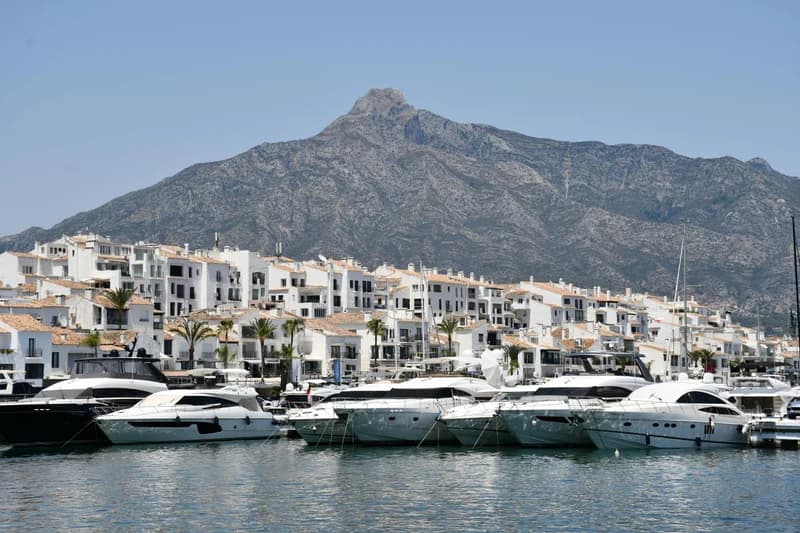
But the real story is further south. The Costa del Sol luxury market transacted €3.2 billion in 2024. Marbella's average price across the market sits at €4,228 per square metre; in premium districts, that figure reaches €30,000 per square metre. More telling still is the operational performance: Marbella's RevPAR in 2024 was €201.30, a national record according to STR and Turespaña data. No other Spanish market came close.
The concentration of branded residence developments on the Costa del Sol is not coincidental. Nine such schemes are currently active or under construction, giving the coast the highest density of branded residences in Europe. The premium that branding commands — documented at 33% to 39% above comparable unbranded product by Savills in 2025 — is not a marketing narrative. It is an empirical pricing differential that shows up in valuations, in exit multiples, and in the appetite of the buyers who fund presales.
The Logic of Patient Capital
Gulf capital arrives in European real estate with a structural advantage that institutional investors from shorter-cycle markets cannot replicate: the mandate to be patient. A sovereign wealth fund with a ten-to-fifteen year horizon does not need to sell into a weak quarter. It can hold through the noise and harvest the mean.
This matters in Spain because the country's real estate market, for all its fundamentals, remains inefficient at the asset level. Pricing is uneven across submarkets. The gap between listed value and achievable transactional value in off-market deals remains wider than in Germany or the Netherlands. For a patient buyer with local relationships and deep legal resource, that inefficiency is not a deterrent — it is the source of the return.
CBRE and JLL both documented a material increase in Gulf capital exposure to Spanish real estate between 2020 and 2024. The trajectory is not a spike driven by a single macro event; it is a gradual reallocation consistent with sovereign wealth mandates diversifying away from hydrocarbon revenues. Post-hydrocarbon diversification is not a strategy under discussion in Riyadh and Abu Dhabi. It is policy already in execution.
What the Numbers Actually Say
Assemble the data points without editorialising and the argument makes itself. A market that absorbs nearly 100 million tourists annually and still grows. A RevPAR trajectory that has posted double-digit growth for three consecutive years. A luxury coastal market with European-record branded residence density and verified pricing premiums of close to 40%. Cap rates that remain above those in comparable Western European gateway cities. And a recovery profile from the deepest hospitality shock in modern history that took eighteen months, not five years.
The Costa del Sol luxury market remains fragmented. Portfolios are held by families, independent operators, and a handful of opportunistic funds that arrived in cycle. That fragmentation creates aggregation windows — precisely the type of operation that Gulf patient capital executes methodically, as the ADIA trajectory across 2022 to 2024 illustrates.
Gulf capital is not discovering Spain. It is confirming what the data has been signalling for years: that the country's hospitality markets offer a rare combination of scale, liquidity, yield, and structural demand that patient capital can hold for a decade and exit into a deeper market than the one it entered.